Fruit Tree Quiet Hour Black and White
A Calm, Thoughtful Design That Stitches With Intention
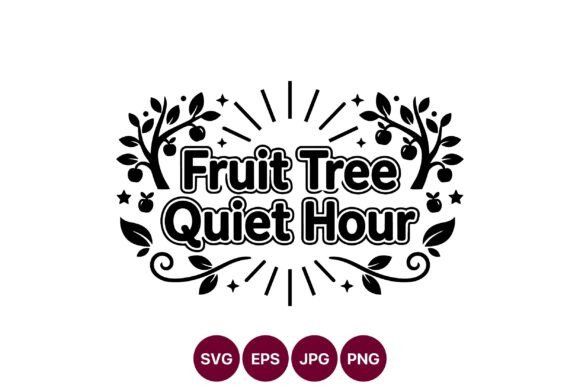
First glance at Fruit Tree Quiet Hour Black and White feels like stepping into a sunlit kitchen at dawn—quiet, grounded, and gently poetic. The phrase “fruit tree quiet hour” sits center stage, wrapped in clean-lined apple branches, delicate leaves, and subtle stars and swirls. It’s not loud or playful; it’s reflective. As an embroidery designer who’s stitched hundreds of phrases for baby onesies, boutique aprons, and personalized tea towels, I immediately sensed its rhythm: unhurried, legible at medium scale, and deeply suited to handmade products that whisper rather than shout.
Where This Design Truly Shines in Real Embroidery Projects
I recently tested Fruit Tree Quiet Hour Black and White on a natural linen tote bag destined for a local herbalist’s shop—and it landed perfectly. The black-and-white vector art translated beautifully into a crisp 3.5-inch hoop embroidery using matte cotton thread. Because the design leans on clean outlines and open negative space—not dense fills—it breathed on the fabric instead of flattening it. That’s rare. Many phrase-based embroidery files drown in satin stitch clutter, but this one trusts simplicity. It works especially well for:
- Sweatshirt embroidery — the balanced weight of the lettering holds up against fleece texture without needing heavy underlay
- Baby embroidery — soft apple motifs feel nurturing, not cutesy; ideal for organic cotton onesies or muslin swaddles
- Embroidered patch — the defined edges and moderate detail make it stable for iron-on or sew-on backing
- Kitchen towel or tea towel design — the stars and swirls add just enough charm without competing with function
- Nursery decor or holiday embroidery — think linen pillow covers or framed hoop art for a gentle, seasonal gift
Where to Pause and Plan Before Stitching
This isn’t a “drop-in-and-stitch” design for every surface—and that’s a strength, not a flaw. Its quiet confidence means it asks for thoughtful placement. On stretchy fabric like ribbed knit tees, I recommend stabilizing heavily beneath and testing the outermost leaf tips—they’re slender and could distort if tension isn’t dialed in. On dark fabric, stick with white or ecru thread (not off-white) to preserve contrast; the design’s elegance relies on clarity, not opacity. And avoid cramming it into hoops smaller than 4 inches—the lettering “quiet hour” drops into fine serif-style strokes that lose definition below 2.75 inches.
The decorative stars and swirls? Lovely in concept—but they’re best appreciated at 3 inches or larger. At tiny scales (think cap front or wristband), those details blur into noise. Likewise, on highly textured fabrics like bouclé or thick terry cloth, simplify: consider stitching only the phrase + one central apple branch, omitting the finer swirls entirely. Less here is more—and more professional.
How It Elevates Your Handmade Product—and Your Customer’s Experience
What surprised me most was how Fruit Tree Quiet Hour Black and White elevated perceived value—not through flash, but through cohesion. When stitched on a heavyweight canvas apron for a small-batch bakery, customers paused. They didn’t just see “embroidery.” They felt the intention behind it: slow food, rooted craft, quiet care. That resonance matters. For Etsy sellers and small shop product creators, this kind of emotional alignment builds trust faster than any tagline. It reads as authentically handmade—not digitally mass-produced.
It also supports brand consistency beautifully. Whether you’re designing a line of botanical-themed nursery goods or launching a series of mindful lifestyle apparel, this design acts as an anchor: timeless, gender-neutral, and seasonally flexible. No dated trends, no forced whimsy. Just quiet strength—ideal for personalized gift offerings where sentiment outweighs spectacle.
Practical Embroidery Designer Notes You’ll Actually Use
Before committing to your first run, do these five things:
- Test on scrap fabric matching your final product—especially if using thin fabric like voile or rayon challis. Watch how the outer branches behave under tension.
- Check thread color contrast in natural light *and* under store lighting. What reads clearly on screen may mute on oat-colored linen.
- Review stitch density in your embroidery software. If fill areas feel overly dense, reduce density by 8–12%—this preserves fabric drape and reduces puckering.
- Confirm hoop size compatibility with your machine and project surface. Curved surfaces like caps demand flatter, lower-profile elements—so consider simplifying the swirls for headwear.
- Verify licensing before selling finished items or bundling as design assets. Since this is listed as Illustrations and Graphics, confirm whether commercial use is included—especially if you plan to offer it as part of a digital embroidery bundle.
Final Thought: A Design That Grows With Your Craft
Fruit Tree Quiet Hour Black and White won’t dominate a tradeshow booth—but it will linger in memory after someone unwraps a linen pouch embroidered with it, or traces the apple branch on a baby’s burp cloth. It’s a machine embroidery design built for meaning over momentum. For creative entrepreneurs, crafters, and apparel decorators who value depth, restraint, and real-world wearability, it’s not just another digital embroidery file. It’s a quiet invitation—to slow down, stitch with care, and let the fruit of your labor speak softly, clearly, and well.