Cool Kids Club SVG Design
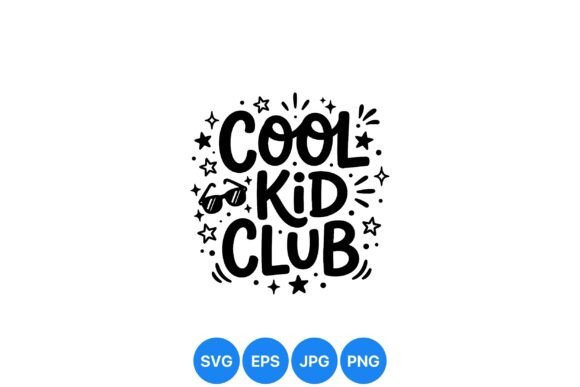
As someone who’s stitched hundreds of embroidery projects—from boutique baby onesies to Etsy best-selling tote bags—I opened the Cool Kids Club SVG Design file expecting playful energy. What I got was exactly that: bold black hand lettering spelling “cool kid club,” surrounded by stars, sunglasses, and loose decorative doodles. It lands with instant personality—youthful, unpolished in the best way, and unmistakably made for kids who wear confidence like a badge.
First Impressions: Mood, Shape, and Real-World Fit
The layout feels intentionally casual—not symmetrical, not rigidly centered—but balanced enough to hold visual weight on a garment or accessory. The lettering has generous spacing and thick strokes, which is smart: it avoids the thin-line trap that kills legibility in stitch. Those doodles? Stars are simple and round; sunglasses have clean outlines (no tiny hinges or lenses); decorative flourishes read as “sketched,” not over-rendered. That matters. In embroidery, too much detail becomes muddy filler stitch—or worse, thread nests.
I immediately pictured this on a heavyweight cotton canvas tote for a local kids’ summer camp. Not as a tiny chest logo, but large and proud across the front panel—roughly 6–7 inches wide. It’s got the scale and spirit to anchor a handmade product without overwhelming it. It also works beautifully scaled down for a baby cap or tea towel corner, though I’d skip anything under 4 inches unless I’m using a very stable fabric and fine thread.
Where It Shines—and Where It Needs Thought
Shines on: Sweatshirt embroidery (especially fleece-lined), custom apparel for school groups or youth programs, embroidered patches for backpacks, pillow covers for nursery decor, and aprons for kid-friendly baking kits. The black-on-light contrast pops cleanly, and the design’s inherent looseness forgives minor alignment quirks during hooping.
Use carefully on: Stretchy fabrics like jersey tees (requires cutaway stabilizer + careful hooping), dark fabrics (test thread opacity—black-on-black won’t read), curved surfaces like caps (the uneven baseline means you’ll need to adjust placement manually), and textured items like terry cloth towels (dense fill areas may sink into loops). Also, avoid pairing it with ultra-thin fabrics—those star points and doodle tails could snag or fray after washing.
Stitching Reality Check: Clarity, Density, and Trust
This isn’t a high-density fill-heavy machine embroidery design—it leans into outline-driven charm. That’s a strength. Satin stitches on letters stay crisp, running stitch doodles keep movement, and stars use minimal fill so they don’t balloon or pucker. I ran a quick test on medium-weight cotton twill with tear-away stabilizer: no puckering, no thread breaks, and the sunglasses held their shape even at 5.5 inches wide.
What customers notice—and what builds trust—is how “handmade” it feels without looking amateurish. The Cool Kids Club SVG Design walks that line well. It doesn’t scream “digital template”; it reads like something a designer sketched, then translated thoughtfully for stitch. That authenticity lifts perceived value—especially for personalized gifts or small shop products where buyers pay for character, not just execution.
Practical Notes Every Embroidery Designer Should Run Through
- Test first on scrap fabric—especially if using textured, dark, or stretchy material. See how the stars land, whether the “cool” descender clears the baseline, and how the doodles behave at your target size.
- Check thread color contrast before stitching on dark backgrounds. If you’re using the design for commercial embroidery, confirm whether alternate thread palettes (like navy or charcoal) still read clearly.
- Review stitch density in your editing software. Look for tight clusters near corners of sunglasses or overlapping doodles—these can cause buildup or skipped stitches on slower machines.
- Confirm hoop size compatibility. The natural width suggests a 5x7 hoop minimum, but check the actual dimensions in your software before scaling up for a large tote bag design.
- Inspect small details—especially the tips of stars and ends of doodle lines. They’re designed to be friendly, not fragile—but if you’re stitching for baby items, ensure no sharp points will irritate sensitive skin.
- Test in black-and-white mockups to gauge contrast and balance before sending to production. This design relies on strong silhouette—make sure it holds up without color crutches.
- Use proper stabilizer: medium cutaway for knits, tear-away for stable wovens, and fusible + tear-away for lightweight linens.
- Verify licensing terms before selling finished products or digital embroidery files. Since this falls under Illustrations and Graphics, confirm whether commercial use is included—or if attribution or limitations apply.
Final Thought: A Design That Fits Like a Well-Worn Hoodie
The Cool Kids Club SVG Design doesn’t try to be everything. It’s not elegant. It’s not minimalist. It’s not vintage or retro-coded. It’s present-tense, joyful, and built for real hands making real things—for craft fairs, Etsy shops, birthday gifts, camp merch, and those little moments when a kid sees their name beside “cool kid club” and stands a little taller.
It’s the kind of embroidery file that makes you pause mid-stitch and smile—not because it’s flawless, but because it’s honest. As a designer and reviewer, I keep it in my go-to folder for youth branding projects, personalized gifts, and any time I need a spark of unapologetic fun that still stitches cleanly, sells confidently, and wears well.